Published on January 21, 2026 | By Forex Insights Desk | 5 min read
The Range Trap: Why the Middle of the Range Eats Accounts
The range trap and why the middle is a tax
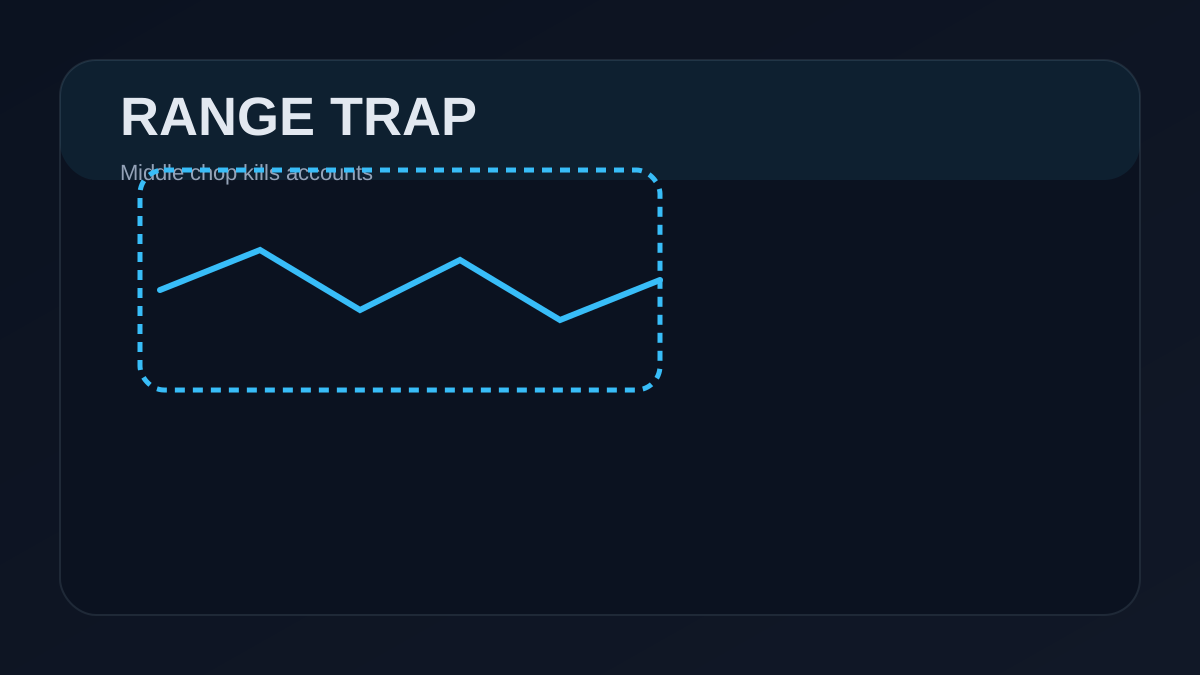
Most FX days are range days. That is not a problem. The problem is that most traders enter in the middle of the range, where there is no real reason for price to move. The middle is a tax. The edge is where the trade is. This post breaks down how to identify a real range, how to trade the edges, and how to avoid the traps that turn a predictable range into a random chop.
What a real range looks like
A true range is defined by repeated reactions at the same high and low zones. These reactions are not perfect ticks. They are zones. If price keeps breaking the level by a large amount, the range is not real. It is a transition. The test is simple: can you draw a zone that captures at least two highs and two lows? If yes, it is likely a range. If no, you should not trade it as one.

Why the middle of the range is a losing zone
Liquidity sits at the edges. Stops sit at the edges. Breakout orders sit at the edges. The middle is just noise. When you trade the middle, you are betting that price will travel to an edge before it travels against you. That is not a statistical edge. Over time, that trade bleeds.
Professionals do not trade the middle. They either fade the edge or wait for the break and reclaim. If you cannot avoid the middle, you will always feel like the market is random. It is not random. You are trading the wrong zone.

Range edges: the high probability zone
The edge is where the market has to make a decision. Either it rejects and returns to the center, or it breaks and transitions to a new regime. Both outcomes are tradable if you wait for confirmation.
Rules that keep you out of trouble:
- Only trade near the top or bottom 20 percent of the range.
- Wait for a clear rejection or reclaim signal.
- Place stops outside the range, not inside it.
The two main range setups
There are only two setups you need in a range. Everything else is noise.
- Edge fade: price tests the boundary, rejects, and you fade back into the range.
- Break and reclaim: price breaks the range, fails, and re-enters. You trade the return.

How to avoid the fake breakout trap
Ranges are filled with fake breakouts because that is where the liquidity sits. A simple filter is to wait for the close back inside the range. If price breaks above the top but closes back inside, that is often the best short opportunity. The same logic applies to the downside.

The sweep and reclaim model
Many ranges end with a liquidity sweep. Price spikes beyond the range, triggers stops, then snaps back inside. That is the sweep and reclaim. It is a high probability setup because it traps breakout traders and gives you a clear invalidation point.

Stops and targets for range trades
Your stop belongs outside the range. If the stop is inside the range, you are just donating money to noise. The target depends on the volatility. In low volatility, take profit near the midpoint. In higher volatility, target the opposite edge. A simple rule is to take partial at the midpoint and leave the rest for the far edge.
Session timing: when ranges hold and when they fail
Ranges are more stable during Asia and early London. They are more likely to fail during major London or New York data releases. If a tier-1 event is scheduled, reduce size or skip the range trade entirely. The range can be broken by one headline.
Common range mistakes
- Entering in the middle because you are bored.
- Placing stops inside the range and getting chopped.
- Fading a breakout without waiting for a reclaim.
- Trading during high impact news releases.
Case study: a textbook range fade
GBPUSD trades in a 40 pip range during Asia. London opens and tests the range high. Price spikes five pips above the high and then closes back inside. You sell the reclaim, place your stop above the sweep wick, and target the midpoint first, then the range low. The trade pays 2R before New York opens. That is a clean range fade. The key was waiting for the reclaim, not guessing at the top.
Build a range checklist
- Are there at least two touches on both edges?
- Is price respecting the boundaries as zones?
- Is there a major news event in the next hour?
- Are you trading the edge, not the middle?
- Is your stop outside the range?
Practice plan
- Mark the range on H1 every day for two weeks.
- Log every edge trade and every middle trade.
- Compare outcomes. The edge should outperform the middle by a wide margin.
- Remove any setup that does not have a clear reclaim signal.
Part 1 note: This is the first expansion pass. I will add deeper case studies, advanced range logic, and multi-timeframe filters in the next pass to reach the full 15k target.